
Over the course of the school day, Dagny Waldron answers to three different names: Dagny, Valentina, and Valentine. Those three names represent her dedication, passion, love and desire for human connection and discussion, traits she plans to carry with her for the rest of her life.
Junior Dagny Waldron takes two world languages at Revere High School (RHS): Spanish and French. In five of her seven classes throughout the day, students and teachers refer to her as Dagny. In the two others, Waldron answers to Valentina and Valentine in her Spanish and French classes, respectively. On Wednesdays, Waldron spends time absorbing, learning and teaching Revere’s elementary school kids American Sign Language (ASL), doing all this because she simply loves communicating with people.
Waldron’s love for language dates back to before she ever stepped foot at Revere. Over the course of her life, she has moved to various different places, living first in Seattle, Washington, and attending Loyal Heights Elementary School. There, Waldron took a Spanish class, and it was there she discovered her interest in involving herself in the language-learning process.
“In elementary school, we had to take Spanish. It was just part of the curriculum, but I just had so much fun, and throughout [my childhood], . . . I downloaded Duolingo [a language-learning app], I filled books with vocabulary,” Waldron said.
Still, that Spanish program in her elementary school days only lasted a few years, and Waldron’s focus shifted from languages onto other subjects. Her love for conversation and communication still stood, especially as she had to adapt to the shifting environment around her throughout middle school when she moved from Seattle to Colorado to Ohio. Coming to Revere Middle School, Waldron then had an opportunity to take three different languages: Spanish, French or Latin. There, one teacher taught Spanish and French within one class period, and students could then go into eighth grade to continue their French or Spanish paths or begin Latin. Waldron, going into the eighth grade at this time, could not choose between Spanish or French, two languages she had learned to fall in love with during her seventh grade year. So she chose both.
“I couldn’t decide. [I] wasn’t just stuck [between Spanish and French]; I really just honestly loved them both. The more that I learned about them, the more I . . . noticed the patterns of conjugation or [had to] learn new vocab, I had so much more fun. . . . I’m not fluent or anything, [but] I just love how they sound, and I love being able to understand and communicate. [Beyond] just being indecisive, I realize[d] that I wanted to do this for my future, and I . . . realize[d] the importance of being able to communicate and how many doors that opens. . . . I can talk to [more] people,” Waldron said.
Now, nearly four years after making the decision to take both Spanish and French as world languages, Waldron has progressed in her abilities, now taking on college-level Spanish and French through Ohio’s College-Credit Plus (CCP) program. To her, the CCP program did not add on any crazy challenges she had not already tackled or that she had not already learned how to address in her previous years with the languages. A challenge she does face, however, is using the wrong language in the wrong class.
“I make so many mistakes, and that’s totally fine. . . . I do work hard to differentiate the two [languages], . . . but the pronunciation I get wrong a lot because I’m just thinking of the wrong [language]. In my most recent English essay, I put ‘sans’ instead of ‘without’ because I thought you could use [‘sans’], but that’s French,” Waldron said.
Still, despite these small errors, there are still several benefits to learning several languages at the same time in school. For RHS French teacher Diane Gerspacher, the positive impacts of the closeness of French and Spanish showed in Waldron’s studies.
“For [Waldron], it has a positive impact because there are so many similarities between [French and Spanish]. So, [for instance], when we started to do the imperfect, she had already done it in Spanish, so she already knew [what the imperfect was]. All she had to do was learn the conjugation in French. She already knew when to use it,” Gerspacher said.
A case like Waldron’s is rare. For most, taking the time to learn one language proves a challenge in itself, and Gerspacher stated that a lot of students take a world language class for the credits or to impress colleges. Having a student double up on a language and continue two for several years throughout high school is “not the most common thing” and it only happens “every so often” according to Gerspacher.
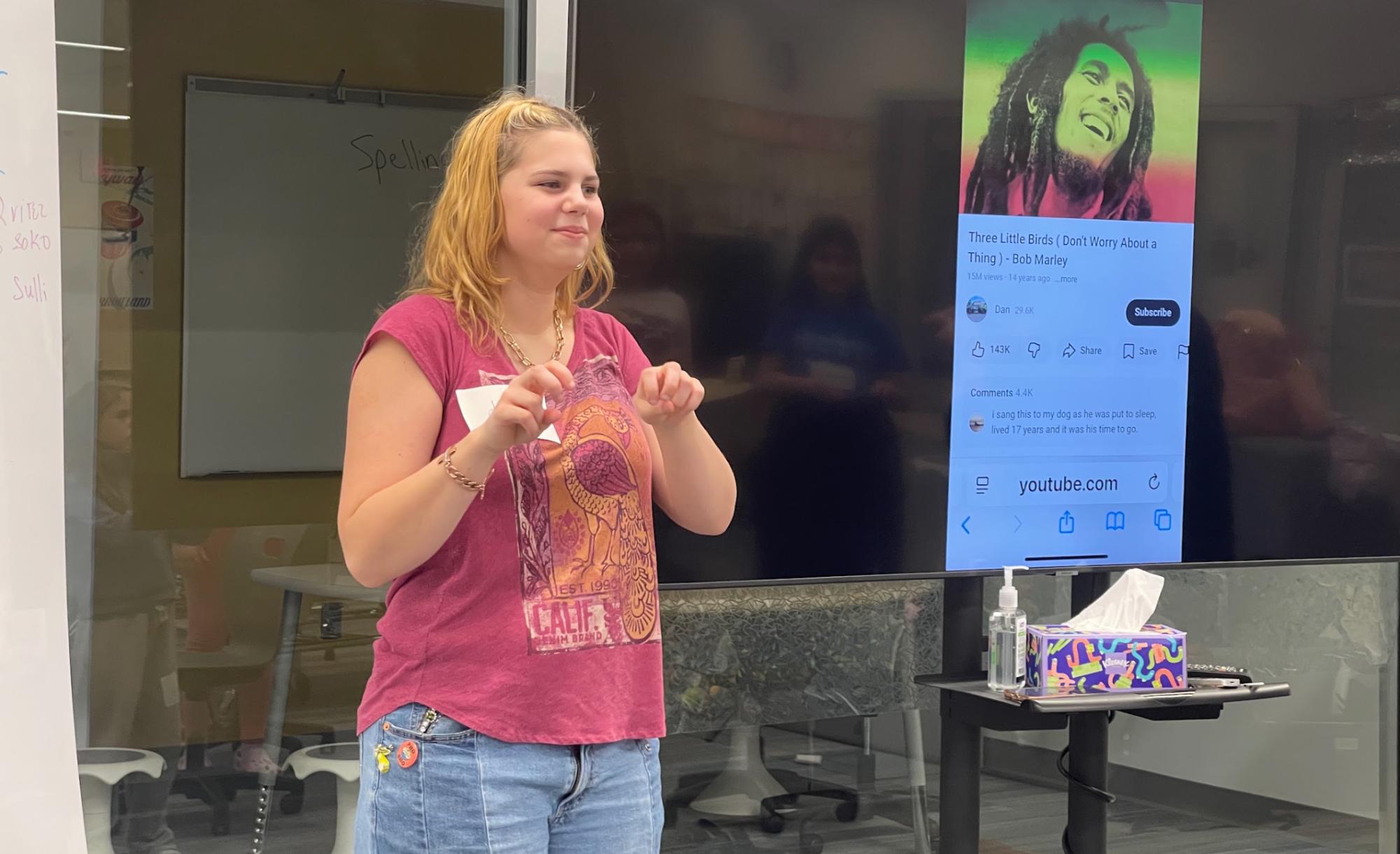
This year, Waldron took on another language-related opportunity: ASL. At the end of the last school year, Revere sent out an email to families, informing them about a volunteer opportunity called Sign Club where RHS students can meet with Revere elementary schoolers to learn ASL. In this sense, Waldron could learn the basics of another language while also spending time talking to and teaching the elementary school students. As someone who has a desire to become a teacher one day, this opportunity aligned with several of her interests.
“Working with kids has always been very fulfilling to me, and it was such a perfect combination of what I would want to learn and what I could do to help, so I decided to do it,” Waldron said.
Rachel Vitez, a sign language interpreter at Bath Elementary School with over forty years of experience, created Sign Club three years ago after a student who communicates through sign language came to the Revere district. In high school, Vitez became inspired to start learning sign language after volunteering at a school for deaf children, and she began interpreting professionally over the next several decades. She now works as that student’s interpreter, and to encourage more of her peers to communicate with that student directly, Vitez began Sign Club. Over the next three years, the club began to expand, and now the club teaches sign language to all the different grade levels at Bath Elementary School.
“I call it the Sign Club. I started it three years ago [when that student] came to Bath [Elementary] School. She was the only deaf, sign language using student in the district, and I wanted to teach her peers how to communicate with her. . . . [In the second year of the club’s existence], we offered Sign Club to all grades [at Bath], and I had two high school seniors who helped [me] run the club,” Vitez said.
Though this is Waldron’s first year with Sign Club, she has nonetheless made an impact on Vitez. She attends all the weekly Wednesday Sign Club meetings, and her desire to work with kids mixed with her excitement around language learning and communicating played into her passion for Sign Club. Now, with the addition of Sign Club, Waldron is actively involved in learning three different languages.
“When I met [Waldron] on the first day of Sign Club, she took directions very well, and she was a natural at connecting with her group. Dagny [Waldron] has a way of seeing what needs to be done and doing it. . . . Dagny has been a natural at picking up the signs and topics presented. She is able to help the students learn or adjust their signs to be more accurate. Willingness is the main need for learning to sign, [and] sign language is a visual language, and it appears that Dagny is a visual person who picks up things quickly. . . . We can always use help in Sign Club, but consistent help is needed the most. I can count on Dagny to show up and help, I can count on her to bring a sweet spirit toward the students. She is great at leading a group and great at making people feel included,” Vitez said.
RHS Spanish teacher Katie Ryan is Waldron’s current Spanish teacher. Ryan, just like Waldron, always loved to study and speak Spanish.
“I just always loved the Spanish language, and I really enjoyed studying it. I was inspired by my high school Spanish teacher. She was so fun, lively, intelligent and inspired a love of language in me as a young freshman,” Ryan said.
With that love of Spanish, Ryan eventually began teaching Spanish as a career and has not looked back since. Just like Ryan, Waldron wishes to pursue a career in teaching Spanish to children as a result of her passion and love for the language as well as her love of sharing, learning and teaching.
“I just love [Spanish]. I couldn’t even tell you why; I don’t even have a connection to Spain or South America, . . . but [the] culture . . . [and] the countries attracted me. The language is so pretty. It’s so fun to speak; I love it. Just something about it makes me smile. . . . The reason I wanna [teach] is because I like facilitating and creating, and I want to be able to create worksheets and help kids learn stuff. Learning and teaching [has] always been a thing I’ve wanted to [do],” Waldron said.
After having met Waldron for the first time this year, Ryan states she is impressed with Waldron’s abilities and her ability to handle the challenges of learning two college-level language classes.
“[Waldron] has a love for language. She uses the Spanish language whenever she can [by] asking questions, asking for clarification; she always strives to use the target language. I’m impressed that [she] can manage two college-level courses . . . in her schedule. Doubling up on a language is very impressive, especially at this level. . . . She’s been crushing it so far,” Ryan said.
Languages, as Waldron stated, resemble puzzles in a way. Remembering words, conjugating, grammar rules and transitioning all work together to create sentences that others can understand, and the ever-evolving reality of languages keeps people learning, even natives. Not knowing everything about any given language is the beauty in it to Waldron; she continues learning new things, and she loves to learn.