
President Woodrow Wilson named November 11, 1919 the “first commemoration of Armistice Day” according to the United States Department of Veterans Affairs (VA). The government established Armistice Day in 1938 to remember the armistice signed back on November 11, 1918 where World War I came to an end. The day initially aimed to celebrate the “heroism of those who died in the country’s service and with gratitude for victory” according to President Wilson, and Americans would celebrate with parades, public meetings, and a brief suspension of business beginning at 11:00 am. In 1954, the 83rd Congress changed the holiday name from “Armistice Day” to “Veterans Day,” and November 11 would become “a day to honor American Veterans of all wars” according to the VA, and the annual observance of Veterans Day would officially become solidified in 1978 thanks to President Gerald R. Ford.
In 1998, Revere hired Jack Cooper who would go on to create several Veterans Day traditions throughout the district.
In 1998, Revere hired Cooper as Bath Elementary School’s intervention specialist. In his short time at Bath, Cooper coordinated an assembly for Veterans Day alongside fifth-grade Revere staff where veterans and their family members attended the assembly. Cooper invited a veteran to give a speech at the assembly, and that veteran presented his story with visual artifacts.
“Mr. Fred Tomei, the building principal [at the time], asked me to coordinate an assembly for Veterans Day. With the help of the fifth-grade teaching team, we invited veterans and their family members to the first formal Veterans Day assembly. I knew a man at our church who parachuted behind enemy lines as part of the D-Day attack by the Allied Forces. I asked him if he would be willing to speak at our school, and he was excited to have been asked. He brought many different artifacts with him, shared his story with the staff, students and visitors, and it was a big hit,” Cooper said.
In late August 2001, three years later, Revere transferred Cooper from Bath to Revere High School (RHS). With the success of Cooper’s Veterans Day assembly efforts, the RHS principal at the time Lee Walker asked Cooper to continue the Veterans Day program at the high school. A few days later, on the tenth day of school, the events of September 11 took place, causing American pride and patriotism to rise according to Cooper. As a result of this terrorist attack on America, the importance of acknowledging Veterans day became increasingly important in the eyes of Cooper and Walker, and the two set out to create a schoolwide assembly to recognize all men and women fighting for the country.
“Before the school year officially began, the [current] principal Mr. Lee Walker asked me to continue the Veterans Day program at the high school as he and his family had been very moved by the ones they attended at Bath. . . . On the tenth day of school, 9/11 took place. Not since the Japanese bombed Pearl Harbor had American pride and patriotism been at such a high level. . . . Because of the patriotism, Veterans Day took on a more important role. . . . [RHS] needed to recognize all the men and women who were deployed and support the families of those fighting. In speaking with Mr. Walker, I indicated my wish to make it a schoolwide assembly where all staff and students were required to attend; he strongly supported that,” Cooper said.
Despite the growing importance of Veterans Day, other RHS staff members believed the assembly would fail as a result of student behavior. Still, Cooper continued to plan the assembly nonetheless, and with the help of the central office secretaries and the English teachers, the Veterans Day assembly would host student guest speakers, community veterans, a community color guard, and a veteran guest speaker.
“Many seasoned teachers kept telling me that student behavior was never good in an assembly and maybe I should reconsider. I stood firm and continued to plan the assembly. The central office secretaries worked on developing a list of veterans in our community to invite, [and] in addition to a guest speaker, the Bath-Richfield Fire Department Color Guard [presented] and post[ed] colors. . . . Our English teachers [had] students write poems and/or essays about veterans [and] Veterans Day, and several of those poems and essays were selected, and the writers read them to the assembly. After the guest speaker finished, Lee Greenwood’s God Bless the U.S.A. played, and the assembly ended. I was so proud of our student body. They proved to me that they could properly behave and be respectful to our guests,” Cooper said.
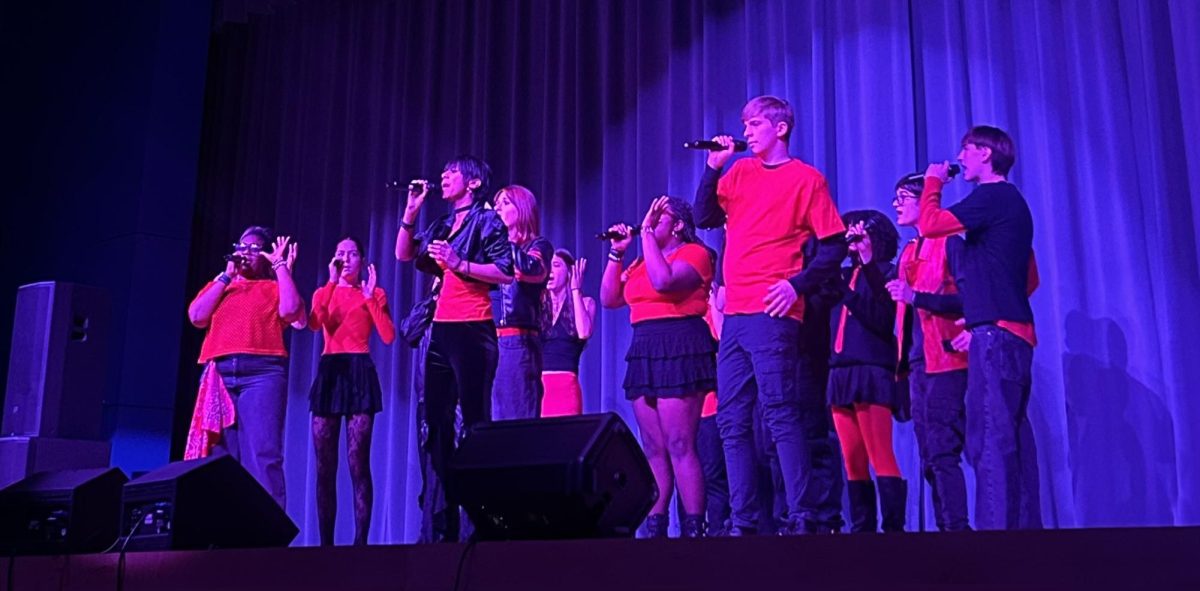
The assembly proved a success. Over the rest of Cooper’s career at RHS, the activities surrounding the would either change, dissipate or stay the same. For instance the Symphonic Choir would sing at the assembly in the 2002 school year, and that event would eventually become tradition over the next two decades. The choir would perform several songs like the National Anthem, Find of Cost of Freedom as well as another hand-picked song to go along with the guest speaker’s speech.
“[In 2002], the Symphonic Choir [sang] at the assembly. . . . Once a guest speaker was confirmed, he or she would let me know what they were going to speak about. [So], in addition to the National Anthem, [the choir director at the time] Deborah Devore looked at music that would go along with the topic of the speaker. We would select two songs for the choir to sing, and at the end of the second song, the choir would begin singing Crosby, Stills, Nash and Young’s song Find the Cost of Freedom. It was performed a cappella, and students would play the guitar, accompanying the choir. It was definitely one of the most popular traditions because right after the choir performed, students would begin asking Dr. Devore if they could play their guitar next year,” Cooper said.
Other events such as PowerPoint presentations honoring each branch, including a moment of silence, Veterans Day videos, a Veterans Day Breakfast prior to the assembly and more would appear between the years 2001 to 2019. Cooper’s involvement in the program helped solidify Revere’s involvement with the veterans within the community, but not without trial and error. Cooper described several activities Revere did over the years for Veterans Day and for the Veterans Day assembly. Some of these activities turned into long-standing traditions that continue at Revere today while others dissipated.
“Other traditions were added over the years [such as] various PowerPoint presentations . . . that honored each branch of the military, [and] as it played, the band would play the anthem of each branch while those in attendance would stand when their branch of service’s anthem played. [We also] added a moment of silence followed by a Taps echo played by two trumpet players from the band. . . . We would have students perform solos, duets, and trios of musical selections honoring veterans. We began having a Veterans breakfast before the assembly began, . . . [and] many of them attended breakfast wearing hats with [their branch or the war they served in] embroidered. . . . Mrs. Debbie Schwertner, [a teacher at the elementary school at the time brought the] first grade[rs] . . . to the veterans at the breakfast. . . . The teachers’ union, the Revere Education Association, would provide coffee and cake in the foyer outside the auditorium for our guests. . . . The social studies department would host a luncheon for the guest speaker and his/her family after the assembly, thanking him or her. . . . The video production classes over the years would film the assembly and then play it over the Revere cable/tv station,” Cooper said.
Not only that, but Cooper and the rest of those working to host the Veterans Day assembly each year would also “recognize” and “honor all the Revere Local Schools employees who had served in the military” as well as “high school seniors who had early enlisted in the military branch” to “show them” how much Revere “appreciated” their “dedication to our country” according to Cooper.
As described above, not all the events lasted. Cooper stated that “everything” Revere did “was a success,” but some just “stood the test of time” while “others were dropped when something new was added to the program.” One example of a dropped activity was the guest speaker luncheon because “many of the guest speakers had other engagements to do immediately after [the assembly],” Cooper said.
Today, Revere has several Veterans Day traditions that did stand the test of time. The choirs still sing songs during the assembly, the Veterans Day Breakfast still continues, the first-grade class still comes in during the aforementioned breakfast to entertain community veterans through song, veterans still often wear hats embroidered with their branches or the war they served in, the assembly still includes a moment of silence followed by two trumpet players from the band, a PowerPoint presentation still plays in thanks of veterans and the band still plays the anthem of each branch while those in attendance stand when their branch of service’s anthem plays. Most importantly, Revere still honors all those who have or will serve in the military. Cooper acknowledges the effort he put into making the program what it is today, but he also names Revere staff as key players in the annual success of the RHS Veterans Day traditions.
“I did a lot to develop a program that was valuable and provided learning opportunities to our students, but it never would have been successful without the support of our staff. I especially appreciate the devotion of the social studies department [in] making this annual event a priority and helping make sure all the pieces and parts come together,” Cooper said.
Cooper’s care and appreciation for veterans developed in part because of his upbringing. As a child, Cooper grew up during the Vietnam War, and he read stories about the “atrocities of war.” When his mother married his stepfather, Cooper learned the “horrible welcome home” his stepfather had received after he returned to the country.
“[My stepfather] stepped on a land mine that injured both of his legs. He spent months in the hospital before being sent home. When his plane deboarded at Cleveland Hopkins airport, he was spit on and called a “baby killer” because he was drafted and served his country,” Cooper said.
Having worked to make the program what it is today, Cooper details how important Veterans Day is, especially in a school setting. High school students today have not lived in a time of war in the same way the veterans visiting Revere had, and the annual breakfast and assembly work to both thank veterans and educate the students.
“The Veterans Day program means the world to me. It provides an annual learning experience for our students, all who have never lived in a time of war that required hand-to-hand combat that encompassed an enormous number of soldiers. . . . The assembly symbolizes the appreciation for what service men and women do to help the United States of America remain free. It is because of them that we are the greatest country in the world,” Cooper said.
Cooper stated he believes Revere’s Veterans Day program found success among the community members stemmed from word of mouth over the years. He also stated he believed that people enjoy seeing teenagers in a positive light, and the respectful nature of Revere students during the Veterans Day assembly impacted the popularity of the program among community members. One of those community members Ray Fribley is a Revere parent and veteran, and he has attended Revere’s Veterans Day assembly for a few years now. As another link in a chain of military men in his family, Fribley began attending Revere’s Veterans Day program when his daughter invited him several years back, and Fribley has attended every year since.
“I had never [gone] to one of these until my daughter invited me. . . . [My son is] a junior here [at Revere], . . . so [he] is my last kiddo, [but] I’ll probably still keep coming to these because I enjoy that [Revere] puts a lot of the work into it. I am very grateful,” Fribley said.
Now that Cooper no longer works at Revere as he has instead moved to working with Rootstown Local Schools as a part-time bus driver, the Revere Veterans Day program had become a part of Cooper’s past. As a result, the bulk of the responsibility for the annual event fell upon the shoulders of other Revere staff, most notably the RHS social studies department. As the head of that department, history teacher Jeff Fry had the responsibility of helping develop the event into what it is today without Cooper, and through taking over the project Fry emphasized how Cooper spearheaded the program when he still worked at Revere.
“Jack Cooper who used to run [the program] with me, he started the whole thing—he was the driver. He did this over the years, and he had help, but he was the man.
He was in charge. He did most of it, and then he donated when he needed to. We [as the RHS staff] picked up a torch from him as a group, not as an individual.
It took a group of us to do what he did because he did really well, and it was awesome,” Fry said.
As Fry and the other Revere staff members began filling Cooper’s shoes in the Veterans Day annual event planning, everyone began taking on responsibility for different parts of the program.
“We share responsibility . . . in our department about different things that each of us does. . . . We have different people that get the speaker, that put the flags out, that [put together] the [Prisoners Of War/Missing In Action] ceremony, . . . [and that] coordinates music,” Fry said.
All over the world, soldiers fight for their countries and for their families. The United States of America recognizes September 11 as a day to honor all soldiers working to fight for the people and their freedoms, and in the Revere sphere, Veterans Day has become an annual event where veterans and their families can enjoy food, celebrations, songs and more. Since 2001, Revere has and will continue to keep this program alive to recognize, thank and honor all the veterans within its community.