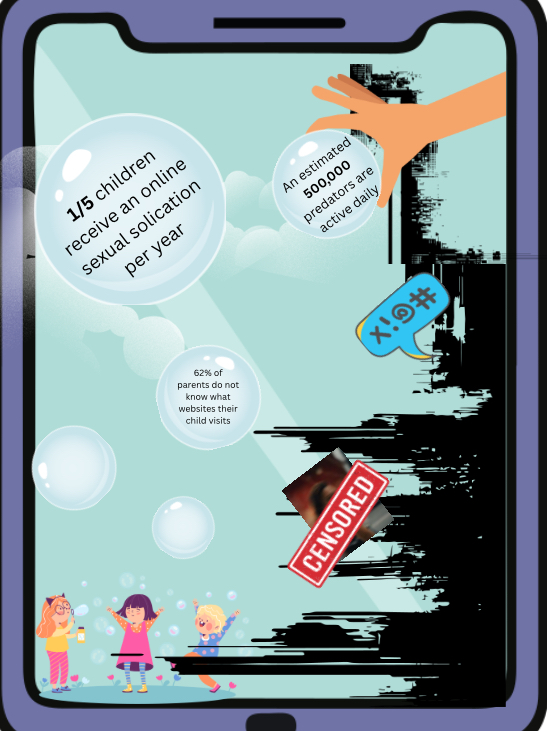
The Revere Connection, Awareness, Resilience & Education (CARE) program hosted a forum to discuss the impact of chat rooms, such as Roblox and Snapchat, on kids, in hopes parents on the dangers of social media.
CARE is a community program geared towards solving problems in the community and bringing awareness to certain issues. Although focused on parents of students at the middle school age, anyone in the community interested in learning more was welcome to attend. The evening began with a presentation from members of Internet Crimes Against Children (ICAC) Emily Fagan-Zirm, the outreach coordinator, and Justin Rotilli, a special agent. The speakers then opened the floor for questions.
ICAC is a nationwide task force of federal and local agencies, often working closely with the Federal Bureau of Investigation (FBI) and Homeland Security to combat predators online. As an agent, Rotilli takes on the role of a 15-year-old girl and tries to reel in perpetrators who prey on vulnerable kids. Bonnie Simonelli, an at-risk coordinator at Revere High School and a part of the CARE program, attended the event and described the difficulty in fighting online crime.
“[CARE] spoke about social media, the dangers of it with kids again. And we can do this every year because . . . very time we think we got an answer to the problem, there’s another problem. [Perpetrators] create another problem. So [Rotilli] was saying you could go over this every six months, it changes that quick,” Simonelli said.
The discussion mainly centered around Snapchat and Roblox because those are two apps that can seem innocent to both parents and kids, but can quickly become dangerous. With Snapchat, messages disappear, creating a false sense of security that may allow students to do things they may not do over text or email. Roblox is primarily a gaming app, but the audience’s age range is widespread, and the chat room aspect of the platform can open a door to online criminals.
“It’s a crime waiting to happen. That’s why Roblox and Snapchat were the two big ones . . . because you can hide behind the gaming kind thing with Roblox, and then disappearing is awesome for perpetrators. They love that,” Simonelli said.
After outlining the dangers of apps, Rotilli and Fagan-Zirm provided examples of ways to combat online predators, such as playing the game with your kid or having them play in an open space. They also brought attention to phone usage at night. Simonelli recounted an example Rotilli shared where parents may not allow their kids to use their phones at night but permit them to use the phone as an alarm clock. Rotilli then made the connection that even though parents said not to, if the phone is in their room, the door is still open to that possibility.
“It’s not because kids are being sneaky. It’s because that’s what they do. I do the same thing. Guess when I’m buying my stuff on TikTok? 11 o’clock at night. So everybody gets it, and it’s just natural. But that’s when these bad people are out there. And it’s so easy to pick the vulnerable kid out,” Simonelli said.
Educating parents on safe practices is the first step in making more kids more aware of how to navigate online spaces. Many parents may have never downloaded Roblox or Snapchat to actually see what their child sees, which is why they may not realize the threat at hand. The Revere Districts School Resource Officer Scott Dressler works with parents and students to help create a better-informed community.
“[Snapchat] is a great tool. I have it, I use it to connect with kids. But it could be used wrong because people get the impression that it disappears after five, ten seconds, and they feel safe using that. But once that thing is put out on the media and somebody else screenshots it or screen records it you have no control over what it is. . . . For parents on Snapchat, there’s For Your Eyes Only and other secret things you can do that parents would never even know what’s on their kids’ phones,” Dressler said.
The goal with creating more awareness, especially around Snapchat and Roblox, is not to create a stigma that anyone using it has bad intentions, but to help people better navigate online to create a safer environment as a whole. Sometimes it may feel like the things one does online are not real, but one’s actions can have serious ramifications in the real world. Dressler often deals with situations specifically surrounding sexual images in which kids may not have realized that what they were doing was illegal.
“If you get an inappropriate image on your phone or somebody sends you something, alert either a school administrator or law enforcement. And not that we’re trying to hammer kids because they have something on their phone, but trying to save them from some type of sextortion or getting caught up in something that they shouldn’t be caught up in,” Dressler said.
This year, the presentation hosted around thirty parents, which, according to Simonelli, is one of the largestlargest crowds they have gotten. CARE will continue to work with ICAC and other organizations to bring awareness to online safety as well as other issues kids are facing in the community.