
With months of preparations behind the scenes team work, the Revere Players brought Camp Neverland: a Peter Pan Story (Camp Neverland) to life for the audience.
Beginning in mid September, the Revere Players prepared every day after school to present a show that comes to life for the audience.
The story is set at a summer camp, with the plot following campers putting on a play about Peter Pan. Kelsey Johnson, the Assistant Director of Players, described the production as being a “play within a play.”
“[This show was] our unique adaptation of Peter Pan where we [were] telling the Peter Pan story within a larger story. Some people might hear Peter Pan and assume [we had] certain effects or [they] might have [had] certain expectations, but this show [was] really different,” Johnson said.
So much of the preparation came from the members of Revere Players who were working behind the scenes. The Players crew is made up of groups that work together to create a professional atmosphere: the actors, backstage crew, technical crew, makeup crew and house crew.
As Assistant Director, Johnson coordinates with Director Sarah Pine and the members of the crew, making sure everything during rehearsals and backstage during the show runs smoothly.
“I see myself as part of a team, and we work together. The adults work with the students to truly bring each production to life,” Johnson said.
The backstage crew, also referred to as the stage crew, creates the backdrop, props and overall stage environment and manages these props during the show.
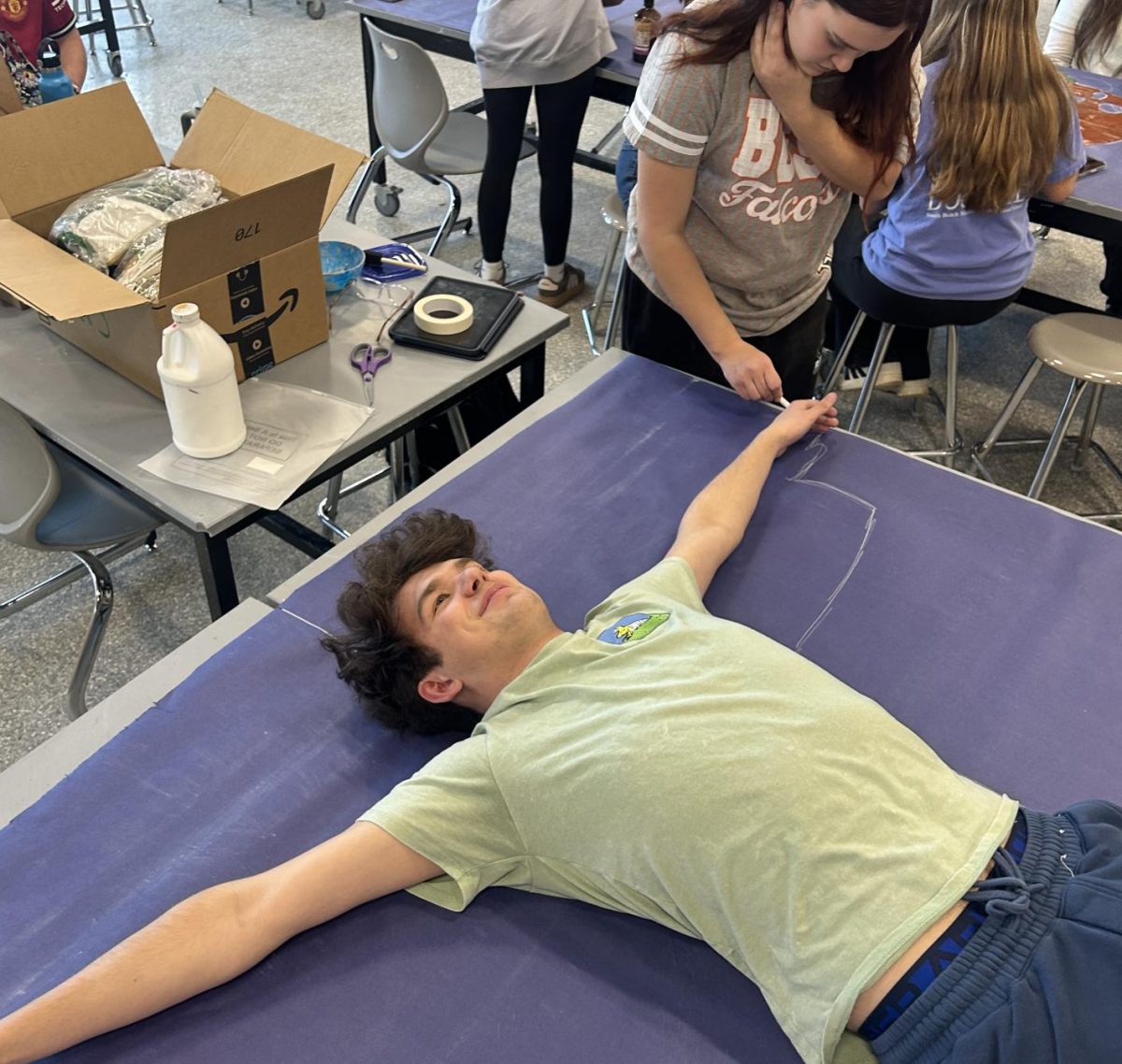
The set construction crew build the props, paint the backdrops and create anything the audience sees onstage. The backstage crew is a small group of students handpicked by the two stage managers from the set construction crew who have dedicated the most amount of time to helping create the set for the show.
“The stage crew is in two stages. First there’s the crew that’s responsible for working on building the set. They are the ones who build props, paint backdrops, anything that you visually see as part of the set. Then during the show, there is a small group who runs all the backstage and makes sure that props are on stage when they need to be and that set pieces are where they need to go,” Johnson said.
Robert Pierson, an art teacher at RHS and the Artistic Director for the Revere Players, leads the group that creates the set. To design the set, Pierson talked with Pine about her vision for the scenery and designed the set to resemble a summer camp in a green forest setting at twilight.
Pierson has worked on set design for the RHS plays for over twenty-five years. Prior to joining Revere Players, he designed the scenery for the Carousel Dinner Theater and the storefronts for Macy’s. For Camp Neverland, Pierson built a climbable, papier mâché tree for the cast to climb on during the play—something he has never done before.
“A climbable tree in the middle of the stage [was] a challenge. We spent a long time on that tree. It was almost like a graf zeppelin on the inside. It was all framed and heavy, and it was all built on a base that was a round table. There was a hesitancy in climbing the tree, so I ended up putting a ladder behind it. It was very successful,” Pierson said.
Members of the set construction crew helped Pierson to paint the large backdrop. With this help, the designs and styling can be more complicated. Pierson compared the style of the backdrop to that of a Van Gogh painting because of its many layers and small brush strokes.
“Since I have thirty people show up to paint, I do designs that are tedious so that people can do dashes. I did a Van Gogh style, not only because it looks cool, but because it is easy to blend,” Pierson said.
This year, the backstage crew had a unique role. Typically, they would mainly be out of sight from the audience, but in this play they will be in the spotlight.
“In this show, [there was] actually a really cool opportunity. We [had] our crew members in costume, and they will be part of the show in a way that they are not typically in. The backstage crew [usually] dresses in all black so you don’t see them, but this time, they are actually going to be in costume and a part of the scenes,” Johnson said.
Amelia Brackett, the co-Stage Manager for stage crew, is responsible for organizing all of the members, making sure everything happens on time and making sure everything runs smoothly backstage. This is Brackett’s first show as co-Stage Manager.
“I am kind of just excited to experience being a Stage Manager for the first time, because I know it is going to be different than all of the other plays I’ve been backstage for. I am excited to learn new things and figure out how to run things my own way,” Brackett said.
The technical crew, also referred to as the tech crew, enhances the work of the backstage crew with lighting to bring out the vibrancy in the backdrops.
“One of the coolest things, when the whole thing comes together, is when we have our light board put different color lights on it, and it pops this backdrop. Right now it’s a backdrop, but once they put those special colored lights on it, and because the light crew knows ‘if I put this light onto the green tree, it is going to do this’, it gives this effect. It really just brings it to life,” Johnson said.
This year, it is Max Richardson’s first year as the Lead Technician. It is his role to communicate with the rest of the technical crew on lighting and sound for the play and train the tech crew members. In the week leading up to the play, the technical crew worked three hours a day to perfect the lighting and microphones and make final preparations for the play.
“It takes a lot of time and practice to be able to make it so everything looks and sounds good. Some people don’t realize how much time it takes to make everything go smoothly,” Richardson said.
Marianne Harrington is a co-head of the makeup crew who, in the hours leading up to the play, helps the cast with their makeup.
“Usually, we want to make sure that they are in their costumes first so they are not getting makeup on there. Some of them realize they should get their mic after their makeup so that we are not getting make up all over their mic. We are trying to develop more of an order instead of them just showing up,” Harrington said.
The house crew is the group that is responsible for audience interaction. They decorate the auditorium, take and sell tickets, sell concessions and usher people to their seats.
Dagny Waldron, first-year House Crew Manager, was tasked with carrying the designs and themes of the play out off the stage to create further immersion for the audience.
“I decided how we . . . decorate[d] the auditorium this year. We [did] a lot bigger stuff this year. . . . This year, we . . . [put] papier-mâché trees on the whole thing, since it is the camp vibe. We are going to incorporate big trees, a big Camp Neverland banner,” Waldron said.
The last week of preparation before the opening night, which is referred to as “Tech Week,” is when all groups merge and integrate all of the elements of their work from the prior months into a polished performance.
“[Tech week is] when the actors have been working on stage, learning their lines [and] learning their movements. The backstage crew has been working since September to build all of this stuff, and now we are bringing the cast, the backstage crew [and] the tech crew all together to become one cohesive unit. If you think of it like you are making a cake, you know in your head what you want that final cake to be. Someone’s making the cake itself, someone’s making the frosting. We know what each other’s doing, but then there is that final moment when it all comes together,” Johnson said.
Opening night of the play is the culmination of hours of work and coordination of the Revere Players.
“We work together from day one to have an understanding of what is needed for the show, because we are always working towards that end result. We know where we want this to be when we are running the show, and we have the audience members here to watch it,” Johnson said.